
Referential and Reviewed International Scientific-Analytical Journal of Ivane Javakhishvili Tbilisi State University, Faculty of Economics and Business






Personalized Service Management in the Tourism and Hospitality Industry: The Role of Intelligent Technologies
Doi.org/10.52340/eab.2026.18.02.09
Personalized service has become one of the key factors in creating competitive advantage in the modern tourism and hospitality industry. The development of digital transformation, artificial intelligence, big data, and advanced customer data management systems has fundamentally changed traditional approaches to customer relationship management and service delivery. Against this background, increasing attention is being paid to assessing the role of intelligent technologies in the development of personalized services.
The aim of this article is to analyze contemporary personalized service models and the practical significance of intelligent technologies in tourist destinations and the hospitality industry. The study is based on a comprehensive methodological approach that combines a systematic review of the contemporary scientific literature, comparative analysis, and content analysis of secondary statistical data.
The research systematizes contemporary conceptual models of personalized service at both destination and hotel industry levels. The findings highlight the growing importance of artificial intelligence (AI), Customer Relationship Management (CRM) and Customer Data Platforms (CDP), Smart CRM, Digital Twin technologies, and hyper-personalization in customer behavior analysis, service adaptation, and the enhancement of customer experience. The analysis of the Georgian case demonstrates that technological transformation is actively taking place in both branded and independent hotels, although with different levels of integration and implementation.
The results confirm that personalization in the tourism and hospitality industry is no longer merely a marketing tool. Instead, it is increasingly evolving into a data-driven strategic mechanism that significantly influences customer satisfaction, loyalty, and organizational competitiveness.
Keywords: Personalization; Artificial Intelligence; Tourism; Hospitality Industry; Smart CRM; Digital Twin; Customer Experience; Competitiveness.
JEL Codes: L83, Z32, O33, C81, M31
Introduction
Conceptual and empirical studies on the development of the global tourism and hospitality industry continue to attract significant scholarly and practical attention. Research interest is particularly concentrated on tourist destinations and the hotel industry, as reflected in the growing number of academic studies and publications in these fields (Tsai, Song, and Wong 2009). In the context of destinations, this trend is largely driven by the fact that destination competitiveness influences not only the generation of tourism revenues but also creates multiplier effects across a wide range of related economic activities. The growing academic and practical interest in the hotel industry is associated with its significant contribution to the global economy, the dynamic development of the sector, the increasing number of market participants, rising customer expectations regarding service quality, and the intensification of competition.
At the present stage, these processes are being significantly influenced by digital transformation, which has fundamentally changed the operating principles of both tourist destinations and hotel companies. As Georgian scholars note, research priorities have gradually shifted toward the academic analysis of innovative technology integration and data-driven management. The adoption of digital platforms, smart infrastructure, big data analytics, and intelligent systems has substantially transformed hotel marketing, visitor flow management, service quality, and safety standards (Baliashvili and Katsitadze 2026). The advancement of Big Data, Artificial Intelligence (AI), Predictive Analytics, Customer Relationship Management (CRM) systems, Customer Data Platforms (CDPs), and other intelligent technologies has significantly enhanced organizations’ ability to analyze customer behavior, identify individual needs and preferences, and develop more personalized service offerings.
Against the backdrop of these developments, personalization has emerged as one of the key strategic priorities in the tourism and hospitality industry. Modern consumers increasingly demand services tailored to their individual needs and expectations, compelling organizations to move from traditional standardized service models toward data-driven and personalized management systems. As a result, personalization is no longer viewed solely as a marketing tool; rather, it is increasingly evolving into a critical mechanism for enhancing customer experience, satisfaction, loyalty, and the creation of competitive advantage.
The concept of customer-oriented management emphasizes the importance of a thorough understanding of customer behavior, expectations, and preferences. Kumar and Reinartz argue that organizations should develop customer data-driven relationship management systems that facilitate the establishment of long-term, value-based relationships with customers (Kumar and Reinartz 2012). Furthermore, contemporary research confirms that the study of consumer behavior increasingly relies on interdisciplinary approaches and data-driven analytical tools, enabling organizations to better understand customer needs and develop more effective personalization strategies (Kotler and Armstrong 2017; Jain 2023).
In light of the above, the aim of this article is to examine contemporary models of personalized service and to assess the practical role of intelligent technologies in tourist destinations and the hotel industry.
The study is based on a comprehensive methodological approach that combines both theoretical and empirical analysis. The theoretical component is grounded in a systematic review of contemporary scientific literature and covers the concept of Smart Tourism, contemporary models of personalized service, and the application of intelligent technologies, including Artificial Intelligence (AI), Smart CRM, and Digital Twin technologies in the tourism and hospitality industry.
A comparative analysis method was employed to examine various personalization models at both the destination and hotel industry levels, as well as to assess the specific features of technological integration in branded and independent accommodation establishments.
The empirical component is based on the content analysis of secondary statistical data obtained from the Georgian National Tourism Administration, the National Statistics Office of Georgia (Geostat), and other official sources. This approach enables the assessment of industry development trends, the relevance of technological transformation, and contemporary directions in the development of personalized services.
Main Text
Recent scientific literature presents a wide range of theoretical and conceptual approaches that examine the role and significance of personalized services in the management of tourist destinations and accommodation establishments.
A notable contribution in this field is the study by Michopoulou and Buhalis, which describes a three-stage personalization process and represents one of the earliest conceptual frameworks for the practical implementation of personalized services (Michopoulou and Buhalis 2013). According to the authors, intelligent technologies and data-driven services can support customers throughout the entire travel cycle—from the planning stage to the completion of the journey. Therefore, personalization in contemporary destination management is viewed as a continuous process encompassing all stages of the tourist experience.
According to researchers, the development of Smart Tourism has the potential to play a significant role in fostering an inclusive tourism environment. Modern digital technologies, automated services, and customer-oriented intelligent systems make it possible to provide tourism services that are more accessible and adaptable to the diverse needs of visitors. Consequently, personalization in contemporary destination management is viewed not only as a means of tailoring services to individual preferences but also as an important instrument for ensuring accessible, flexible, and inclusive tourism experiences for different categories of visitors.
According to Buhalis and Amaranggana (Buhalis and Amaranggana 2015), the concept of a Smart Tourism Destination is based on data-driven management and the application of intelligent technologies, enabling destinations to better understand visitor behavior, forecast demand, and create personalized tourism experiences. This approach is further developed by Cerdá-Mansilla et al., who conceptualize a tourist destination as a holistic digital ecosystem in which technological infrastructure, governance mechanisms, visitors, and other stakeholders operate within an integrated system (Cerdá-Mansilla et al. 2024).
El Archi et al. argue that contemporary tourist destinations increasingly rely on Artificial Intelligence (AI), Big Data, and other data-driven technologies to deliver personalized services. These technologies enable destinations to analyze visitor behavior in real time, generate personalized recommendations, and enhance the overall quality of the tourism experience (El Archi et al. 2023).
These trends confirm that personalization has become one of the key directions in the management of contemporary tourist destinations. At the same time, similar principles and technological approaches are being actively adopted within the hotel industry, where personalization is increasingly regarded as an important tool for creating and sustaining competitive advantage.
While personalization at the destination level is primarily associated with managing the visitor journey, tourism experiences, and the broader digital ecosystem, in the hotel industry it serves as a key instrument for customer relationship management, service customization, and the enhancement of guest experience.
This issue is examined from an operational management perspective by Prasad and Dev (2000), who associate the creation of competitive advantage in the contemporary hotel industry with the integration of technological innovation, brand value, and customer-oriented management. According to the authors, Customer Relationship Management (CRM) systems serve as important tools for collecting and analyzing guest data, as well as facilitating personalized communication, thereby contributing to higher levels of customer satisfaction, loyalty, and repeat visitation. This approach laid the foundation for the development of data-driven marketing and contemporary personalization systems.
Contemporary studies (Payne and Frow 2005; Buttle 2009; Kumar and Reinartz 2012) confirm that Customer Relationship Management (CRM) and Customer Data Platform (CDP) solutions constitute important technological foundations for guest data centralization, behavioral analytics, and personalized service delivery. While CRM primarily focuses on managing customer relationships and organizing communication processes, CDPs integrate customer data from multiple sources and create a unified customer profile, commonly referred to as a Single Customer View. Lilien et al., Tealium, and Gartner emphasize that the primary advantage of Customer Data Platforms (CDPs) lies in their ability to centralize customer data and enable Real-Time Activation. This capability allows organizations to respond rapidly to changes in customer behavior and deliver personalized services across multiple communication channels (Lilien et al. 2013; Tealium 2021; Gartner 2021).
In the tourism and hospitality industry, the integration of CRM and CDP systems combines data from Property Management Systems (PMS), booking engines, websites, social media platforms, loyalty programs, and other digital channels, enabling a deeper analysis of customer behavior, demand forecasting, and the development of personalized offerings. Their integration with the Internet of Things (IoT), Big Data, and Artificial Intelligence (AI) technologies creates a data-driven ecosystem that facilitates service adaptation, enhances operational efficiency, and improves customer experience.
The further development of CRM systems laid the foundation for the emergence of the Smart CRM concept (Pattnaik and Samal 2025), which integrates traditional CRM functionalities with Big Data Analytics, Industry 4.0 technologies, and machine learning capabilities. According to the authors, Smart CRM systems facilitate demand forecasting, the generation of personalized offers, and the enhancement of guest experience, thereby contributing directly to higher levels of customer satisfaction and loyalty.
Digital Twin is considered one of the most promising technological innovations in the contemporary hotel industry. It enables the creation of digital replicas of physical assets and operational processes and is used for analyzing guest behavior, optimizing resource utilization, supporting predictive maintenance, and enhancing operational decision-making (Vicomtech 2022; Mohan 2025). Existing studies indicate that the integration of Digital Twin technology improves guest experience, increases operational efficiency, and positively affects financial performance indicators, including Average Daily Rate (ADR) and Revenue per Available Room (RevPAR).
Mu et al. associate the current stage of personalization development with the emergence of hyper-personalization, which is based on real-time data analysis, predictive analytics, and the utilization of customer behavioral insights. This approach enables organizations to deliver highly customized services tailored to the individual needs and preferences of each customer, thereby enhancing customer experience and strengthening competitive advantage (Mu et al. 2025).
Nira proposes a three-component model of personalized service (Inputs–Transformation Mechanisms–Outputs), according to which data, technological resources, and analytical systems are transformed into value-creating mechanisms for customers and sources of competitive advantage for organizations (Nira 2025).
To systematize the reviewed studies and facilitate their comparative analysis, an analytical table was developed summarizing contemporary models of personalized service and their practical significance in tourist destinations and hotel companies (see Table 1).
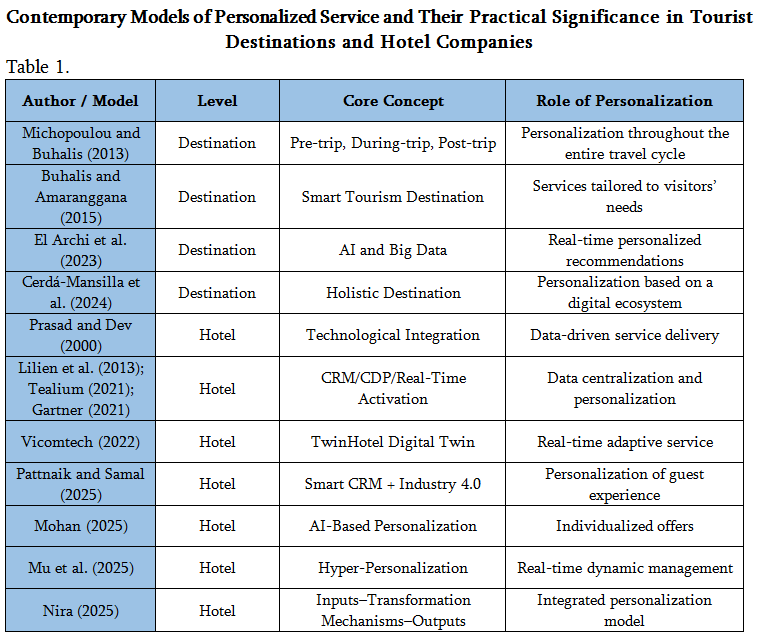
Source: Compiled by the author based on the reviewed scientific literature.
Thus, contemporary research confirms that a comprehensive understanding of customer behavior, experiences, and perceptions constitutes a fundamental prerequisite for the development of personalized services. These principles underpin the personalization models currently implemented in tourist destinations and the hotel industry, which increasingly rely on data analytics, digital technologies, and customer-oriented management approaches.
Against the backdrop of ongoing technological changes in the global tourism and hospitality industry, the analysis of Georgian practice is of particular interest. In recent years, Georgia’s tourism and hospitality industry has demonstrated a steady growth trend, reflected in the increasing number of international visitors, tourism revenues, and the key economic indicators of the accommodation sector.
According to the Georgian National Tourism Administration, the number of visits made by international visitors reached 6.9 million in 2025, representing a 6.2% increase compared to 2024. The most frequently visited regions included Tbilisi, Adjara, and Mtskheta-Mtianeti, while the highest demand for leisure and recreational tourism was recorded in Adjara, Tbilisi, Mtskheta-Mtianeti, Imereti, and Samtskhe-Javakheti (Georgian National Tourism Administration 2025).
This trend confirms that Georgia’s diverse tourism and recreational resources, cultural and historical heritage, natural landscapes, and gastronomic tourism play a significant role in strengthening the country’s position in the international tourism market.
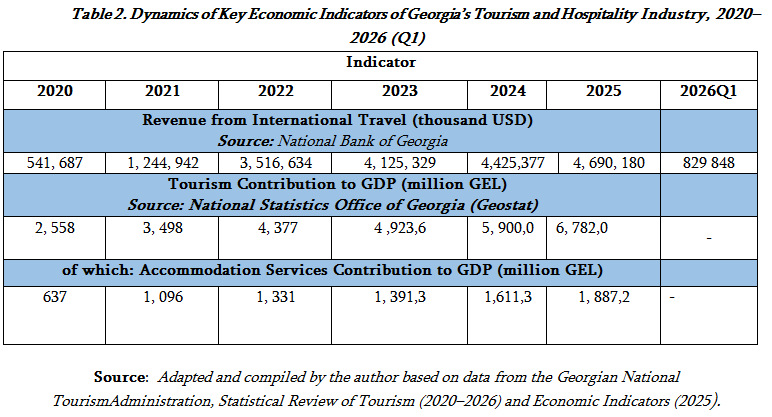
The growth of tourism is also reflected in the sector’s economic performance. Revenue generated from international travel increased from USD 541.7 million in 2020 to USD 4.69 billion in 2025, while tourism’s contribution to the country’s Gross Domestic Product (GDP) exceeded GEL 6.7 billion.
A similar growth trend can be observed in the accommodation sector, whose economic significance and contribution to the country’s GDP have increased substantially. While the contribution of accommodation services to GDP amounted to GEL 637 million in 2020, this figure nearly tripled, reaching GEL 1,887.2 million by 2025 (see Table 2).
The analysis of recent statistical data confirms a stable growth trend in both the number of accommodation establishments and the key economic indicators associated with Georgia’s hotel industry. In particular, the revenues of tourism-related enterprises increased from GEL 228.7 million in 2020 to GEL 1,104.2 million in 2024.
A similar trend is evident in the volume of expenditures incurred by international visitors on accommodation services, which reached approximately GEL 4.8 billion in 2024. Although comprehensive economic indicators for accommodation establishments are not yet available for 2025, the existing statistical evidence suggests the continuation of positive sectoral dynamics. Specifically, according to the Georgian National Tourism Administration, as of the first quarter of 2026, the number of accommodation establishments reached 2,691, while expenditures on accommodation services amounted to GEL 573 million (Tourism in Figures: Statistical Review of Tourism in Georgia, Q1 2026).
At the same time, positive dynamics were also observed in the occupancy rates of branded hotels, indicating growing demand and increased market activity within the sector. To better illustrate these trends, the relevant data are presented in Table 3

The structure of Georgia’s hotel market is characterized by a diverse range of accommodation establishments, including hotels, family-run hotels, guesthouses, and other types of lodging facilities. One of the key features of the sector is the coexistence of international and local brands, which contributes to market diversification and the development of a competitive business environment.
Since 2019, Georgia has experienced a continuous expansion of international hotel chains. Various regions of the country host internationally recognized hotel groups and brands, including Marriott International, Hilton Worldwide, InterContinental Hotels Group (IHG), Wyndham Hotels & Resorts, Accor Group, Radisson Hotel Group, Millennium Hotels and Resorts, and others (Katsitadze, Baliashvili, and Kutateladze 2023; Georgian National Tourism Administration 2025).
It should also be noted that the impact of technological innovation is evident in both branded and independent hotels, although the scale and degree of integration differ considerably. In branded hotels, technological transformation is typically implemented through centralized corporate standards and integrated management systems. The combined use of Property Management Systems (PMS), Customer Relationship Management (CRM) platforms, and Revenue Management Systems (RMS), together with AI-driven dynamic pricing, predictive maintenance, Digital Twin technologies, and modern guest experience metrics such as Net Promoter Score (NPS) and Customer Effort Score (CES), enables these hotels to enhance operational efficiency, improve service quality, and strengthen customer loyalty.
In contrast, the adoption of technological solutions in independent hotels is often constrained by limited financial, technological, and human resources, resulting in a more fragmented pattern of technology implementation. Nevertheless, cloud-based Property Management Systems (Cloud PMS), Customer Relationship Management (CRM) platforms, Online Travel Agency (OTA) channel management tools, and automated booking solutions enable independent hotels to improve customer communication, increase digital sales, and incorporate elements of personalized service delivery (Baliashvili and Katsitadze 2026).
Importantly, the use of data-driven marketing, customer segmentation, and personalization tools is increasing across both market segments. The development of digital platforms and online distribution channels enhances market accessibility, improves customer experience, and contributes to the strengthening of competitive positions.
Thus, the ongoing technological transformation of Georgia’s tourism and hospitality industry is gradually creating new opportunities for the development of personalized services. Although the scale of technological innovation adoption differs between branded and independent hotels, both segments demonstrate a growing reliance on data-driven management, digital marketing, and customer-oriented approaches. These trends represent important prerequisites for enhancing the sector’s competitiveness and ensuring its sustainable development.
Conclusion:
• The findings of this study indicate that personalization has emerged as one of the key strategic priorities in the contemporary tourism and hospitality industry. The analysis of the scientific literature confirms that the development of personalized services is closely associated with the application of intelligent technologies, including Artificial Intelligence (AI), Big Data, Customer Relationship Management (CRM) and Customer Data Platform (CDP) solutions, Smart CRM systems, and Digital Twin technologies. These innovations enable organizations to gain deeper insights into customer behavior, needs, and preferences and to develop tailored service offerings that positively influence customer experience, satisfaction, and loyalty;
• The analysis of Georgian practice confirmed that the ongoing technological transformation in the tourism and hospitality industry is taking place in both branded and independent hotels, albeit at different scales and levels of integration. Despite these differences, both segments demonstrate an increasing adoption of data-driven marketing, digital sales channels, and personalized service tools. Therefore, in today’s competitive environment, personalization can no longer be viewed merely as a marketing instrument; rather, it has evolved into a key mechanism for creating competitive advantage, enhancing customer experience, and supporting the sustainable development of the sector..
The analysis of Georgian practice confirmed that the ongoing technological transformation in the tourism and hospitality industry is taking place in both branded and independent hotels, albeit at different scales and levels of integration. Despite these differences, both segments demonstrate an increasing adoption of data-driven marketing, digital sales channels, and personalized service tools. Therefore, in today’s competitive environment, personalization can no longer be viewed merely as a marketing instrument; rather, it has evolved into a key mechanism for creating competitive advantage, enhancing customer experience, and supporting the sustainable development of the sector.
Based on the findings of the study, it is recommended that companies operating in the tourism and hospitality industry implement integrated CRM, Customer Data Platform (CDP), and AI-based analytical systems. Such integration facilitates effective customer data management, supports the development of personalized services, and enables data-driven decision-making. This approach can contribute to higher levels of customer satisfaction, loyalty, and business competitiveness in both branded and independent hotels.
References:
• Baliashvili, E., and N. Katsitadze. 2026. “Technological Innovation Management as a Key Driver of Success and Sustainable Development in the Modern Hotel Services Industry.” Moambe, Georgian Academy of Business Sciences. https://doi.org/10.52340/gbsab.2026.57.01;
• Buhalis, Dimitrios, and Azin Amaranggana. 2015. “Smart Tourism Destinations: Enhancing Tourism Experience through Personalisation of Services.” In Information and Communication Technologies in Tourism 2015, edited by Iis Tussyadiah and Alessandro Inversini, 377–389. Cham: Springer;
• Buttle, Francis. 2009. Customer Relationship Management: Concepts and Technologies. 2nd ed. Oxford: Elsevier;
• Cerdá-Mansilla, Elena, Iis Tussyadiah, Sara Campo, and Natalia Rubio. 2024. “Smart Destinations: A Holistic View from Researchers and Managers to Tourists and Locals.” Tourism Management Perspectives 51: 101223. https://doi.org/10.1016/j.tmp.2024.101223;
• El Archi, Youssef, Brahim Benbba, Zhulduz Nizamatdinova, Yerlan Issakov, Ivett Vargáné Gálicz, and Lóránt Dénes Dávid. 2023. “Systematic Literature Review Analysing Smart Tourism Destinations in Context of Sustainable Development: Current Applications and Future Directions.” Sustainability 15 (6): 5086. https://doi.org/10.3390/su15065086;
• Gartner. 2021. Magic Quadrant for Customer Data Platforms. Gartner Research;
• Georgian National Tourism Administration (GNTA). 2020–2025. Tourism in Figures; Statistical Review of Tourism; International Visitor Survey. Tbilisi: GNTA;
• Geostat (National Statistics Office of Georgia). 2025. Statistical Yearbook of Georgia 2025. Tbilisi: Geostat;
• Jain, Nick. 2023. “What Is Consumer Behavior Research? Definition, Examples, Methods, and Questions.” September 8, 2023;
• Katsitadze, N., E. Baliashvili, and M. Kutateladze. 2023. “The Trends of the Hotel Industry Development in International and Georgian Markets.” Economics & Business 4. https://doi.org/10.56079;
• Kotler, Philip, and Gary Armstrong. 2017. Marketing: An Introduction. 7th ed. Harlow: Pearson;
• Kumar, V., and Werner Reinartz. 2012. Customer Relationship Management: Concept, Strategy, and Tools. Berlin: Springer;
• Lilien, Gary L., Arvind Rangaswamy, and Arnaud De Bruyn. 2013. Principles of Marketing Engineering and Analytics. 2nd ed. New York: Routledge. https://doi.org/10.4324/9781315871639;
• Michopoulou, Eleni, and Dimitrios Buhalis. 2013. “Information Provision for Challenging Markets: The Case of Accessible Tourism.” Tourism Management 35: 212–220. https://doi.org/10.1016/j.tourman.2012.06.010;
• Mohan, P. 2025. Digital Twin Integration in Hospitality Management: A Data-Driven Framework for Operational Efficiency and Revenue Optimization. Singapore: Springer. https://doi.org/10.1007/978-981-99-8877-1;
• Nira, S. 2025. “AI-Driven Hyper-Personalization in Hospitality: Applications, Opportunities, Challenges, and Guest Trust Issues.” Journal of Hospitality Technology 11 (2): 145–162;
• Pattnaik, Sudhansu Sekhar, and Ansuman Samal. 2025. “Smart CRM Practices and Guest Satisfaction: A Modern Perspective on Hotel Marketing.” International Journal of Environmental Sciences 11 (6): 754–766;
• Payne, Adrian, and Pennie Frow. 2005. “A Strategic Framework for Customer Relationship Management.” Journal of Marketing 69 (4): 167–176. https://doi.org/10.1509/jmkg.2005.69.4.167;
• Prasad, K., and Chekitan S. Dev. 2000. “Managing Hotel Brand Equity: A Customer-Centric Framework for Assessing Performance.” Cornell Hotel and Restaurant Administration Quarterly 41 (3): 22–31. https://doi.org/10.1177/001088040004100314;
• Tealium. 2021. CDP Explained: A Comprehensive Guide to Customer Data Platforms;
• Vicomtech. 2022. TwinHotel: Digital Twin for Smart Hotel Management. San Sebastián: Vicomtech Technology Center.