
Referential and Reviewed International Scientific-Analytical Journal of Ivane Javakhishvili Tbilisi State University, Faculty of Economics and Business

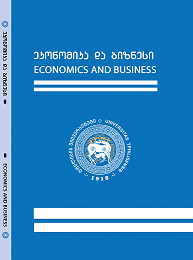










„ECONOMICS and BUZINESS“ VOLUM XVIII, N2, 2026
C O N T E N T
ECONOMIC THEORY ◊ ECONOMIC POLICY
Temur Shengelia, Nino Adamia - The Influence of Institutional Factors on the Development of Small and MediumSized Innovative Entrepreneurship
Irakli Kovzanadze - Global Economic Development Trends Amid Ingreasing Geopolitical Risks
Khatuna Berishvili, Mariam Arnadze - The EU Green Deal and Georgia: Economic Impact and Development Prospects of the Green Transition
Davit Bakradze - TemurCorporate Economic System: A New Institutional Model for Regional Development
Giorgi Kokhreidze - Assessment of the Monetary Condition Index: The case of Georgian Economy
Aliyeva Zhala Rahman - Challenges and Solutions in the Development of Inclusive Education for Persons with Disabilities in Azerbaijan
MANAGMENT ◊ MARKETING ◊ Tourism
Davit Narmania, Eka Chokheli, Rusudan Seturidze, Giuli Keshelashvili, Manana Kharkheli, Ekaterine Gulua, Nino Aptsiauri, Gvantsa Eristavi - Digital Transformation in University Governance: Assessing Efficiency and Transparency from an Al Perspective
Nugzar Todua, Levan Kalmakhelidze - The Impact of Digital Content on Online Shopping Consumer Behavior
Elisabed Baliashvili - Personalized Service Management in the Tourism and Hospitality Industry: The Role of Intelligent Technologies
FINANCE and BANKING ◊ ACCAUNTING and AUDIT
Salome Akhvlediani - Managerial Accounting as an Integrated System for Financial, Operational and Sustainability Performance: A Theoretical and Conceptual Analysis
Nino Chavleshili - Methodology for Enterprise Leverage Analysis and Financial Risk Assessment in Strategic Management
SECTORAL ECONOMICS
Demur Sichinava, Mikheil Machitidze, Shorena Davitaia - Cybersecurity of Energy Infrastructure in Georgia: Technological and Governance Gaps
Miron Tugushi - Key Directions for Unemployment Regulation in Georgia
Lela Aduashvili - Competitive Environment in the Vegetable Market in Georgia:Empirical Evidence of Consumer Behavior 22
ANNIVERSARIES
Professor Elguja Mekvabishvili 70
2026-07-06
The Influence of Institutional Factors on the Development of Small and Medium-Sized Innovative Entrepreneurship
doi.org/10.52340/eab.2026.18.02.01 journal N2.2026 Innovative entrepreneurship is one of the most dynamically developing sectors of the Georgian economy, driving the country\\\'s transition from a traditional resource-based model toward a knowledge-based economy. Its development is not a spontaneous phenomenon but rather the outcome of institutional evolution. In this regard, examining the institutional factors that shape innovative progress and conducting their fundamental analysis is essential for formulating effective state policy, underscoring the significance of this scientific inquiry. The purpose of this research is to assess the impact of the institutional environment on the development of innovative entrepreneurship within Georgia’s small and medium sized enterprises. Amid intensifying global competition and the transformation of economic systems, analyzing the factors that foster or impede business innovation – where the institutional environment plays a2026-07-06
Global Economic Development Trends Amid Ingreasing Geopolitical Risks
Doi.org/10.52340/eab.2026.18.02.02 This article is devoted to the analysis of trends in the development of the global economy in the context of increasing geopolitical risks. It examines the dynamics of economic output and inflation, as well as the state of public finances and the balance of payments. Particular attention is paid to the current situation in the economy and banking sector of Georgia.Based on a comparative analysis of international and domestic economic indicators, the article outlines the principal challenges and opportunities facing Georgia and offers conclusions regarding the policy measures required to support sustainable economic growth, financial stability and long-term development in an increasingly complex geopolitical landscape. Keywords: Global economy, global crisis, geopolitical conflicts, geopolitical risks, GDP growth, inflation, unemployment rate, investment, balance of payments, public finances, budget deficit, public debt.JEL Codes: E60, F51, F40,2026-07-06
The EU Green Deal and Georgia: Economic Impact and Development Prospects of the Green Transition
Doi.org/10.52340/eab.2026.18.02.03 Against the backdrop of intensifying climate change, environmental degradation, and growing economic vulnerability, the European Green Deal has emerged as one of the most comprehensive policy frameworks for transforming economic systems toward climate neutrality, sustainability, and resilience. Adopted by the European Union in 2019, it sets a long-term vision of achieving net-zero greenhouse gas emissions by 2050, while simultaneously fostering economic growth, technological innovation, and social cohesion. Although primarily designed for EU member states, the Green Deal’s scope and regulatory influence extend beyond the Union’s borders, significantly impacting partner countries such as Georgia, which is gradually aligning its economic and environmental policies with European standards through the Association Agreement and sectoral cooperation mechanisms.This article explores the economic implications of the green transition in Georgia2026-07-06
Temur-Corporate Economic System: A New Institutional Model for Regional Development
Doi.org/10.52340/eab.2026.18.02.04 This article examines the concept of a community-corporate economic system as a new institutional model for regional development in Georgia. The proposed model aims to address several structural challenges confronting the country’s economy, including regional inequality, depopulation of rural areas, and the concentration of economic resources in a limited number of urban centers.The community-corporate economic system is based on the principles of economic decentralization, local capital formation, and community participation in economic activity through shareholder mechanisms. Within this framework, local communities are considered active economic units rather than merely administrative entities. Residents participate in economic processes as shareholders, while local governance structures coordinate economic initiatives at the community, municipal, and national levels.The article analyzes the institutional architecture of the model,2026-07-06
Assessment of the Monetary Condition Index: The Case of Georgian Economy
Doi.org/10.52340/eab.2026.18.02.05 In the economic literature, considerable attention is devoted to the study of inflation. Rising price levels can negatively affect a country’s socio-economic conditions. Nevertheless, moderate inflation is often regarded as one of the guarantors of stability. To achieve this stability, inflationary shocks are managed through state monetary policy. The effectiveness of such policy largely depends on the specific characteristics of the country, public trust in the central bank, and the broader economic situation. The Monetary Conditions Index (MCI), developed by the Bank of Canada in the late 1980s, is a weighted average of interest rates and exchange rates. It provides a means of assessing the stance of monetary policy, as both indicators – interest rates and exchange rates – serve as transmission mechanisms and influence inflation levels (Memon and Jabeen, 2018). MCI is frequently used for short-term operational assessments of2026-07-06
Challenges and Solutions in the Development of Inclusive Education for Persons with Disabilities in Azerbaijan
Doi.org/10.52340/eab.2026.18.02.06 This paper examines the challenges and prospects for the development of inclusive education for children with disabilities in Azerbaijan. The aim of the study is to identify the main barriers to the realization of the right to education for children with limited health capabilities. The hypothesis suggests that eliminating institutional and infrastructural barriers can significantly improve accessibility and quality of education for this group. A qualitative analysis of the regulatory framework and statistical data is conducted, with an additional focus on the interpretation of state policy. The findings indicate that despite some progress, significant structural and resource limitations remain, hindering the effective implementation of inclusion. The theoretical significance of the research lies in substantiating the connection between inclusive education and sustainable development, while its practical significance is reflected in providing2026-07-06
Digital Transformation in University Governance: Assessing Efficiency and Transparency from an Al Perspective
Doi.org/10.52340/eab.2026.18.02.07 Digital transformation has become an important component of university governance. Universities increasingly employ enterprise resource planning systems, learning management platforms, business intelligence tools, electronic governance solutions, and other digital applications to support both academic and administrative processes. Yet, the mere presence of digital tools does not automatically mean that an institution has achieved effective transformation. The value of technology depends on its integration into everyday governance, the quality of infrastructure, staff competencies, managerial support and organizational culture. Artificial intelligence introduces a new stage of this process by offering opportunities for automation, data analysis and decision support, while also raising questions about privacy, accountability and algorithmic transparency. This study aimed to examine the relationship between digital technology integration, perceived2026-07-06
The Impact of Digital Content on Online Shopping Consumer Behavior
Doi.org/10.52340/eab.2026.18.02.08 The paper highlights digital content marketing as a new and increasingly important strategy in today\\'s business world. Consequently, the influence of digital content on consumer behavior has become a significant focus for contemporary researchers. However, there is a scarcity of detailed studies in the scientific literature addressing the factors that define digital content within online commerce. This issue is particularly relevant in the context of Georgia, where digital marketing is rapidly evolving. In Georgia, the impact of content marketing on consumers\\' online behavior remains largely unexplored, which consequently hampers business development in this area. Given this situation, special attention is devoted to emotional and behavioral factors—especially attitudes toward brands and purchase intentions. Our study aims to investigate consumer perceptions of digital content related to online commerce. Based on the analysis of diverse2026-07-06
Personalized Service Management in the Tourism and Hospitality Industry: The Role of Intelligent Technologies
Doi.org/10.52340/eab.2026.18.02.09 Personalized service has become one of the key factors in creating competitive advantage in the modern tourism and hospitality industry. The development of digital transformation, artificial intelligence, big data, and advanced customer data management systems has fundamentally changed traditional approaches to customer relationship management and service delivery. Against this background, increasing attention is being paid to assessing the role of intelligent technologies in the development of personalized services.The aim of this article is to analyze contemporary personalized service models and the practical significance of intelligent technologies in tourist destinations and the hospitality industry. The study is based on a comprehensive methodological approach that combines a systematic review of the contemporary scientific literature, comparative analysis, and content analysis of secondary statistical data.The research systematizes2026-07-06
Managerial Accounting as an Integrated System for Financial, Operational and Sustainability Performance: A Theoretical and Conceptual Analysis
Doi.org/10.52340/eab.2026.18.02.10 This paper examines the role of managerial accounting in modern organizations, framing it as an integrated system for managing financial, operational, and sustainability performance. Grounded in a theoretical and conceptual approach, the study uses the hospitality industry as a sectoral illustration, with particular reference to the Uniform System of Accounts for the Lodging Industry (USALI) as an analytical framework. The research is motivated by the growing complexity of today’s economic environment, marked by expanding regulatory requirements, market volatility, and heightened stakeholder expectations for transparency, accountability, and sustainable development. Under such conditions, organizations must adopt management systems that simultaneously ensure financial stability, operational efficiency, and the integration of sustainability objectives. In Georgia, the hospitality and tourism sector plays a pivotal role in economic development,2026-07-06
Methodology for Enterprise Leverage Analysis and Financial Risk Assessment in Strategic Management.
Doi.org/10.52340/eab.2026.18.02.11 The paper titled “Improving the Methodology of Corporate Leverage Analysis” examines both the theoretical and practical dimensions of financial stability and risk management in modern enterprises. In today’s economic environment, a company’s sustainability depends largely on the accurate identification and effective management of risks, which form the foundation of sound managerial decision-making. The introductory section addresses the diversity of risks and their impact on corporate financial performance. It emphasizes that risks are an inherent feature of contemporary business, and neglecting them can result in substantial financial losses. Accordingly, risk management represents not only an economic necessity but also a strategic imperative. Special attention is given to the international standard ISO 31000, which provides a unified framework for risk management. Its revised 2018 edition places stronger emphasis on2026-07-06
Cybersecurity of Energy Infrastructure in Georgia: Technological and Governance Gaps
Doi.org/10.52340/eab.2026.18.02.12 Energy infrastructure represents one of the most critical components of national infrastructure, as its reliable and uninterrupted functioning directly affects economic stability, social welfare, industrial productivity, and national security. Modern societies rely heavily on continuous electricity supply for the operation of essential services, including transportation systems, telecommunications networks, healthcare institutions, financial services, and government operations. Consequently, the resilience and reliability of energy systems have become a central concern for policymakers, infrastructure operators, and security experts worldwide. Over the past two decades, the energy sector has undergone significant technological transformation driven by the rapid advancement of digital technologies and the increasing integration of information and operational systems. This digitalization has enabled the deployment of advanced monitoring systems,2026-07-06
Key Directions for Unemployment Regulation in Georgia
Doi.org/10.52340/eab.2026.18.02.13 As a result of government measures implemented in recent years, Georgia’s unemployment rate has declined to some extent; nevertheless, it remains high, at 13.3% of the economically active population. Moreover, unlike in previous years, the number of individuals classified as “outside the labor force” is strikingly large—nearly equal to the total number of unemployed—which is cause for concern. A substantial share of this group (working-age individuals who are neither employed nor seeking employment) may consist of external migrants. Whatever the reason, the government must take a proactive role in identifying the factors behind the inactivity of this segment of the working-age population. The sooner those currently “outside the labor force” are integrated into social and economic activities as a potential workforce, the more favorable the overall outcome will be. To improve the employment and2026-07-06
Competitive Environment in the Vegetable Market in Georgia: Empirical Evidence of Consumer Behavior
Doi.org/10.52340/eab.2026.18.02.14 This article investigates the competitive environment of the vegetable market in Georgia using empirical evidence drawn from consumer behavior. Moving beyond the traditional price-centered view of market competition, the study examines how preferences, perceptions, and purchasing patterns shape the actual model of rivalry between local and imported vegetables. The research is based on a survey of 456 respondents and integrates consumer theory with applied econometric analysis to identify the determinants of purchasing decisions and the structure of demand across different income groups. The conceptual framework builds on Lancaster’s consumer characteristics approach, Samuelson’s revealed preferences perspective, and Simon’s notion of bounded rationality. These perspectives enable the study to interpret consumer choice not merely as price optimization, but as a process shaped by perceived quality, trust, and informational signals.2026-07-06